What is an archetype and how does it fit into my work? #writing

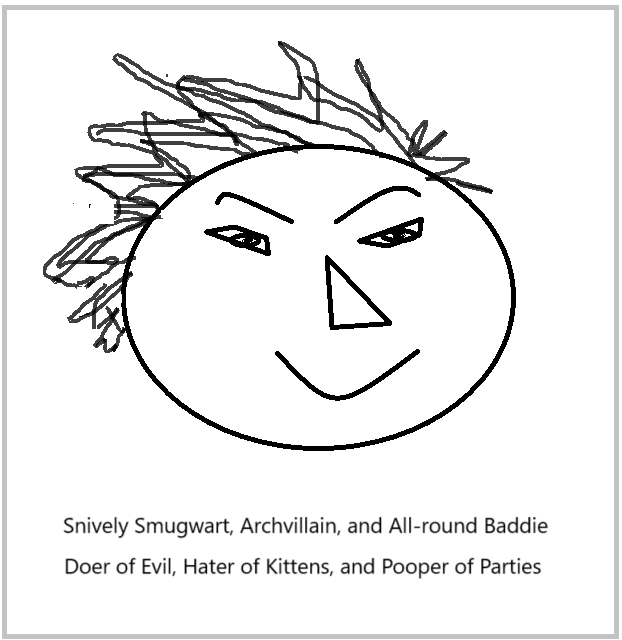
If you write fiction, you are making use of an archetype, whether you know it or not. In literature, the word archetype describes the kinds of characters and plots featured in stories across all cultures and eras of human history.
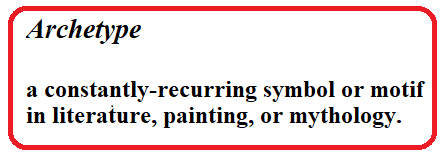
Even in our ancient past, when we had little communication with other cultures, our myths and legends shared common, recognizable characters we call archetypes.

The Writer’s Journey, Mythic Structure for Writers, by Christopher Vogler, details the various traditional types of characters that are featured in mythology and our modern literary canon. His work is based on Joseph Campbell‘s book, The Hero With a Thousand Faces,
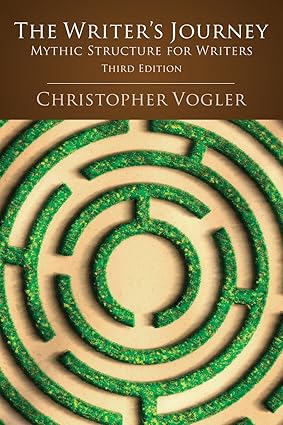
The following is Christopher Vogler’s list of character types [1] who are the heroes and villains in every story:

  1. Hero: someone who is willing to sacrifice his own needs on behalf of others.
  2. Mentor: all the characters who teach and protect heroes and give them gifts.
  3. Threshold Guardian: a menacing face to the hero, but if understood, they can be overcome.
  4. Herald: a force that brings a new challenge to the hero.
  5. Shapeshifter: characters who constantly change from the hero’s point of view.
  6. Shadow: a character who represents the energy of the dark side.
  7. Ally: someone who travels with the hero through the journey, serving a variety of functions.
  8. Trickster: embodies the energies of mischief and desire for change.

So, there we have the characters. Now we need a story. Christopher Booker, author of The Seven Basic Plots: Why We Tell Stories [2], tells us that the following basic archetypes underpin the plots of all stories:

  1. Overcoming the Monster

  2. Rags to Riches

  3. The Quest

  4. Voyage and Return

  5. Comedy

  6. Tragedy

  7. Rebirth

  8. I would add an eighth: Romance

We feel comfortable with these basic recognizable storylines, no matter how differently they are presented to us. No matter the story, if it is fiction, we have characters in familiar roles, acting out familiar plots.

Yet, despite the basic similarity of these characters and plots and their ancient origins, they are the basis of our modern literary canon. Every author has a story to tell, and it is their imagination, style, and voice that make it new and unique.
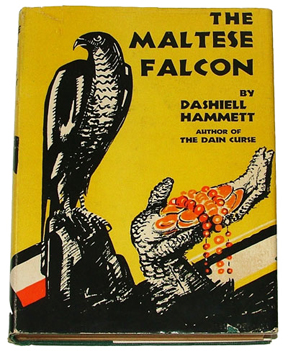
Let’s consider two famous novels. First, we’ll look at The Maltese Falcon, by Dashiell Hammett.

This is a detective novel, a thriller, nothing at all like our other novel, J.R.R. Tolkien’s The Hobbit, which is an epic fantasy quest tale.

However different it looks on the surface, The Maltese Falcon is definitely a quest tale.

The genre of this tale is classic thriller with a film noir flavor. Yes, it’s a quest featuring a hero and a villain, but delivered with a twist.

Sam Spade is a hardboiled, cynical private eye. He is hired to retrieve a jeweled statue, the Maltese Falcon. However, the statue itself is a MacGuffin. The MacGuffin’s importance to the plot is not the object or goal itself, but rather the effect it has on the characters and their motivations. In this case, the quest changes Sam’s life. The sole purpose of the MacGuffin is to move the plot forward.
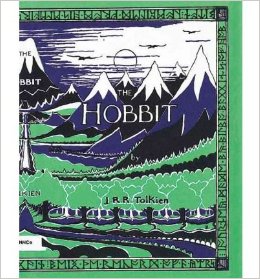
In The Hobbit, home-loving Bilbo Baggins is a comfortable, upper-middle-class hobbit who is tricked into hosting a group of strangers for a dinner. Overcome by a moment of rashness, he joins the wizard Gandalf and the thirteen dwarves of Thorin’s Company. The obvious quest is for Bilbo to break into a dragon’s lair, acting as a burglar to reclaim the dwarves’ home and treasure from the dragon Smaug.

Through the process of fulfilling his burglar tasks, Bilbo finds the Arkenstone, an heirloom jewel prized above all else by the leader of the dwarves, Thorin Oakenshield.

It is a MacGuffin.
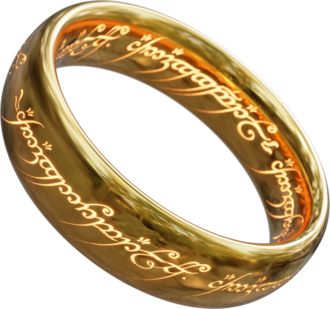
the one ringIn fact, the entire quest, from the moment he leaves home until the day he returns, is a MacGuffin. This is because its sole purpose is to force Bilbo’s personal growth and place him where he will find the One Ring, which will be featured as a core quest in later stories.

By the end of The Maltese Falcon, we learn that the object of the quest was not the purported “Maltese Falcon” after all, despite the lengths they go to acquire it and the efforts the characters expend in the process. The true core of the story is the internal journey of both Sam Spade (the hero) and Brigid O’Shaunessy (the ally/shapeshifter/trickster), two people brought together by the quest, and whose lives are changed by it.

Similarly, the true object of The Hobbit’s quest is not the reclamation of the dwarves’ heritage and treasure. It is how Bilbo Baggins is changed by his experiences and the people he meets on the journey.

So, The Hobbit and The Maltese Falcon begin with the same character archetype of the hero.

  • Bilbo (the hero) is hired to steal the Arkenstone for Thorin and the dwarves.
  • Sam Spade (the hero) is hired to obtain the Maltese Falcon for Brigid O’Shaunessy.

In both tales, another archetypal role that appears is that of the mentor: Bilbo has Gandalf the Wizard, and Sam Spade has Caspar Gutman. Despite their very different personalities and reasons for offering wisdom, both are mentors. Both offer advice that advances the plot.
Both Brigid O’Shaunessy and Thorin Oakenshield begin as allies but prove to be tricksters, shapeshifting and becoming the shadow.

In each tale, the hero endures hardship to acquire an object (the Maltese Falcon or the Arkenstone), only to find that it is no longer as important as he thought. In the process of their journeys, both find joy and sorrow.

Sam Spade never acquires the true Maltese Falcon but finds out who really killed his business partner. He loses much in the process and emerges a different man.

Bilbo Baggins loses his naïveté, and after all the work of finally finding it, he hides the treasured Arkenstone. He does this because of Thorin’s greed and uncharitable actions toward the Wood-elves and the Lake-men who have suffered from the Dragon’s depredations.

And as anyone can tell you, despite their being written in the same era, and the similarities of their archetypal plots and characters, they are radically different novels.

And that is the beauty of the deeper level of the story.

Something so fundamentally similar as plot archetypes and character archetypes emerges completely unique and (on the surface) wildly dissimilar from others when told by different storytellers.

So, while there may be no “new” stories, your voice, your originality and imaginative twists make the story new and memorable.


Credits and attributions:

IMAGE: The One Ring, Wikimedia Commons contributors, “File:One Ring Blender Render.png,” Wikimedia Commons, https://commons.wikimedia.org/w/index.php?title=File:One_Ring_Blender_Render.png&oldid=1051100432 (accessed January 3, 2026).

[1] Wikipedia contributors, “Archetype,”Wikipedia, The Free Encyclopedia ,https://en.wikipedia.org/w/index.php?title=Archetype&oldid=1321105373 (accessed January 3, 2026).

[2] Christopher Booker (2004). The seven basic plots: why we tell stories. London: Continuum. ISBN 978-0826452092. OCLC 57131450.

Wikipedia contributors, “The Writer’s Journey: Mythic Structure for Writers,”Wikipedia, The Free Encyclopedia,https://en.wikipedia.org/w/index.php?title=The_Writer%27s_Journey:_Mythic_Structure_for_Writers&oldid=1324459018 (accessed January 3, 2026)

2 Comments

Filed under writing

#FineArtFriday: Rembrandt and Saskia in the Parable of the Prodigal Son by Rembrandt van Rijn 1635

Rembrandt and Saskia as the Prodigal Son.

Artist: Rembrandt (1606–1669)

Title: Rembrandt and Saskia in the parable of the Prodigal Son

Depicted people: Rembrandt and his wife, Saskia van Uylenburgh

Date: 1635

Medium: oil on canvas

Dimensions: height: 161 cm (63.3 in) width: 131 cm (51.5 in)

Current location: Staatliche Kunstsammlungen Dresden

What I love about this painting:

This was done during the best years of Rembrandt’s life, the years when he was a popular young artist, a time when he was financially secure. He was deeply in love with his wife and at the time of this painting, the future looked bright.

In many ways, Rembrandt was the embodiment of the traditional view of the parable of the prodigal son. He was fond of luxuries that he couldn’t quite afford, sure of his talents, and determined to have his own way in life regardless of the accepted morality of his society.

The two people shown in this painting were happy and knew how to celebrate life, which is clearly shown in this self-portrait.

About this painting via Wikipedia:

It portrays two people who had been identified as Rembrandt himself and his wife Saskia. In the Protestant contemporary world, the theme of the prodigal son was a frequent subject for works of art due to its moral background. Rembrandt himself painted a Return of the Prodigal Son in 1669.

The left side of the canvas was cut, perhaps by the artist himself, to remove secondary characters and focus the observer’s attention on the main theme. [1]

About the Artist, via Wikipedia:

Rembrandt Harmenszoon van Rijn; 15 July 1606 – 4 October 1669), known as Rembrandt, was a Dutch Golden Age painterprintmaker, and draughtsman. He is generally considered one of the greatest visual artists in the history of Western art. It is estimated that Rembrandt’s surviving works amount to about three hundred paintings, three hundred etchings, and several hundred drawings.

Unlike most Dutch painters of the 17th century, Rembrandt’s works depict a wide range of styles and subject matter, from portraits and self-portraits to landscapes, genre scenes, allegorical and historical scenes, biblical and mythological subjects and animal studies. His contributions to art came in a period that historians call the Dutch Golden Age. [2]

To learn more about this artist and his remarkable (and often sad) life, go to Rembrandt – Wikipedia.

For an excellent biography on the life and works of Rembrandt van Rijn via YouTube, go to: Rembrandt van Rijn: Tragedy, Genius and the Art of Light | Full Documentary


Credits and Attributions:

IMAGE: Wikipedia contributors, “The Prodigal Son in the Brothel,” Wikipedia, The Free Encyclopedia, https://en.wikipedia.org/w/index.php?title=The_Prodigal_Son_in_the_Brothel&oldid=1292671149 (accessed January 1, 2026). [1]

Wikipedia contributors, “Rembrandt,” Wikipedia, The Free Encyclopedia, https://en.wikipedia.org/w/index.php?title=Rembrandt&oldid=1329139620 (accessed January 1, 2026). [2]

1 Comment

Filed under #FineArtFriday

Character development: #writing the mentor

No matter the genre, from sci-fi to romance, a mentor shows up to offer needed information that helps the protagonist succeed in their quest. I write fantasy, so certain themes figure prominently in my work. Often, the theme that shapes the main character’s arc is the hero’s journey or, possibly, coming-of-age. These are strong themes, and in stories where the character arc is shaped by them, one of the side characters can serve as a mentor.

Writing Craft Series: the mentorThe mentor can take many forms. Creating a mentor with depth and a sense of history without going off on a tangent is tricky. This is where my writing group is so helpful. Their thoughts and opinions enable me to narrow the focus, helping me create a character who empowers my intended plot arc, but doesn’t take over the story.

I often think about the people who guided me when I was young. In my case, my father encouraged me to never stop learning. But the person who had the most influence on my view of family was my maternal grandmother. She was an amazing woman, and I aspire to be the kind of person she was.

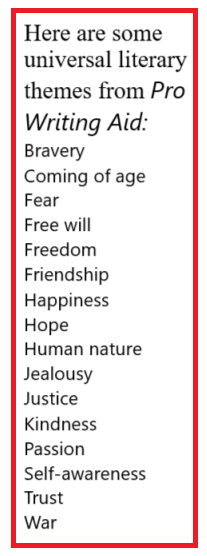
Some universal literary themes, such as bravery, fear, hope, etc.She never lectured or preached, but she knew things, and I learned by observing her. She had an Edwardian childhood and a Roaring Twenties adulthood. Family was the most important thing to her.

She understood that life is a series of learning from our mistakes but expected us to do what was right. Watching her taught me that true wisdom is not about having all the answers. It is about doing the best you can with what you have and finding joy in the small things.

Wisdom is a word that symbolizes a myriad of ideas. In a mentor, it can signify knowledge of fundamental human truths. Perhaps their naïve enjoyment of life has long gone, but in its place is the ability to enjoy the now, to be truly present in life.

The story will tell you what sort of mentor it requires. Some mentors can provide food and shelter, momentary comfort, and an opportunity to heal and regroup. Through their actions and conversation, these mentors can dispense needed wisdom.

Others are more formal: a leader who trains the protagonist in a craft, such as weaponry or magic, something needed to fulfil the quest.

Experience makes a person wiser and can change the personalities of our characters. Perhaps one becomes hardened as a form of self-preservation. That person can become the Han Solo kind of mentor.

Conversely, life experiences can make a mentor more understanding of human frailty.

Let’s look at Aragorn, from the Lord of the Rings Trilogy.

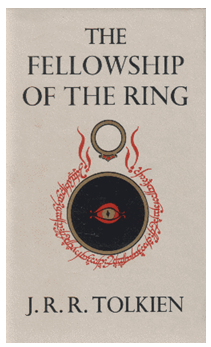
Cover image for The Fellowship of the Ring by JRR TolkienTolkien was crafty. The scene where Aragorn is first introduced makes us wary. The man we meet is mysterious and seems a little dangerous. Yet there is more to him than we see in the dark, smoky taproom of the Prancing Pony, and we wonder about him. At that point, he is only known as Strider, and in that role, he offers them the information they need.

In the chapter titled “Strider,” Frodo reads Gandalf’s letter. Having read it, Frodo says, “I think one of his (Sauron’s) spies would – well, seem fairer and feel fouler, if you understand.”

“I see,” laughed Strider. “I look foul and feel fair. Is that it? All that is gold does not glitter, not all those who wander are lost.” [1]

In the scene, Aragorn is quoting a poem that is later revealed to reference him and his birthright. These are wise words from a poem-within-the-story, a signature literary device Tolkien used regularly.

“All that is gold does not glitter,

Not all those who wander are lost;

The old that is strong does not wither,

Deep roots are not reached by the frost.”

With that quote, he cautions Frodo to look beyond the surface and see the strength that lies beneath. He suggests that the converse can be true, that beauty can disguise what is evil.

In Aragorn, we have a mentor who is wise from life experience and somewhat hardened to the discomforts of his exile. But he is also kind, a person who cares about even the smallest people. He is later revealed to be the heir of Isildur, the sole remaining scion of the fabled last King of Gondor.

Yet, at this stage, he is approaching middle age and may as well be heir of nothing. The respectable landlord of the Prancing Pony looks down on him, seeing Aragorn as little more than a vagrant. Here, he is only known as Strider, leader of the Rangers. These soldiers are not merely mercenaries; they are the Dúnedain of the North, the descendants of his ancestor’s knights.

In the guise of Strider, Aragorn is a good mentor from the first moment we meet him. The reader understands this because he is shown to have a history. Tolkien does this perfectly as the backstory is only hinted at.

Frodo knows nothing about him, other than he is a friend of Gandalf. But Frodo has a good sense about people, and something tells him Strider can be trusted. Our protagonist listens to his counsel even when he disagrees with it.

When we create a mentor character, we must give the reader reasons to believe they have the wisdom our protagonist needs.

At the outset, when we find Strider in the Prancing Pony observing Frodo making the worst possible blunder, we know instantly that there is more to this man than is seen on the surface.

“Well? Why did you do that? Worse than anything your friends could have said! You have put your foot in it! Or should I say your finger?” ~ Strider, The Fellowship of the Ring. [1]

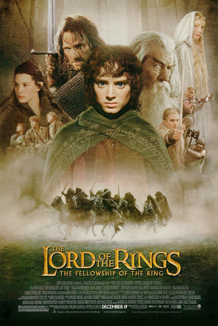
Movie poster for the Fellowship of the RingIn that scene, we meet a person who knows about the secret Frodo carries. Despite Frodo’s error, Tolkien’s portrayal of him makes us believe that he won’t try to steal it, that he is honorable. Here is a person who genuinely wants to help Frodo escape the Black Riders.

We hope that Frodo will listen to him despite his (justifiable) paranoia and Sam’s misgivings.

When I create a mentor in a story, I hope to convey a sense of history without beating the reader over the head with it. I want to evoke a feeling of rightness, that this person knows things we don’t, that this person has knowledge our protagonist must gain.

Hopefully, the insights of my own mentors (my writing group) will guide me to write memorable narratives filled with characters who leave an impact.


Credits and Attributions:

[1] Quote from The Fellowship of the Ring, by J.R.R. Tolkien, Publisher: Houghton Mifflin Harcourt; Illustrated edition, published 29 July 1954. (accessed December 28, 2025) Fair Use.

The Lord of the Rings: The Fellowship of the Ring theatrical release poster. Wikipedia contributors, “The Lord of the Rings: The Fellowship of the Ring,”Wikipedia, The Free Encyclopedia,https://en.wikipedia.org/w/index.php?title=The_Lord_of_the_Rings:_The_Fellowship_of_the_Ring&oldid=1329784385(accessed December 28, 2025).

Wikipedia contributors, “The Fellowship of the Ring,”Wikipedia, The Free Encyclopedia,https://en.wikipedia.org/w/index.php?title=The_Fellowship_of_the_Ring&oldid=1329646864(accessed December 28, 2025).

1 Comment

Filed under writing

#FineArtFriday: “Bringing Home the Yule Log,” A Victorian Christmas Card

This lovely, whimsical card is a brilliant example of the art that can be found on Christmas cards, which became popular in the late 19th and 20th centuries, and while they have fallen out of favor for many nowadays, I still love the art.

About Christmas Cards, via Wikipedia:

The production of Christmas cards was, throughout the 20th century, a profitable business for many stationery manufacturers, with the design of cards continually evolving with changing tastes and printing techniques. The now widely recognized brand Hallmark Cards was established in 1913 by Joyce Hall with the help of brother Rollie Hall to market their self-produced Christmas cards. The Hall brothers capitalized on a growing desire for more personalized greeting cards, and reached critical success when the outbreak of World War I increased demand for cards to send to soldiers. [1]

I love the sentiment expressed at the bottom of this card:

“While Christmas is here, be all of good cheer.”

Christmas Day has gone, leaving behind the memory of cozy warmth, of a table laden with comfort food, sharing a holiday meal with one of my sons and a dear friend. Leaving the memory of talking with my other son and the daughters who live far away.

The old year is nearly over, and while the weather has been unusually stormy this last month, I have far more blessings than I can count.

My Christmas wish for you is: May you never lack for good food, warmth, and the companionship of people you love. May you always have books to read, and may happiness regularly cross your path.


Credits and Attributions:

IMAGE: Wikimedia Commons contributors, “File:Victorian Christmas Card – 11222221966.jpg,” Wikimedia Commons, https://commons.wikimedia.org/w/index.php?title=File:Victorian_Christmas_Card_-_11222221966.jpg&oldid=470244728 (accessed December 24, 2025).

[1] Wikipedia contributors, “Christmas card,” Wikipedia, The Free Encyclopedia, https://en.wikipedia.org/w/index.php?title=Christmas_card&oldid=1321585292 (accessed December 26, 2025).

8 Comments

Filed under #FineArtFriday, writing

My favorite audiobook, “A Christmas Carol,” narrated by @AaronVolner

It’s that time of year when I seek out and enjoy every version of my favorite Christmas story of all time, A Christmas Carol, by Charles Dickens.

The best version is the original. My dear friend (and one of my favorite indie authors) Aaron Volner is an amazing narrator. In 2023, he posted his reading of the original manuscript of A Christmas Carol on YouTube. It is read exactly as written by Charles Dickens and is a wonderful rendition.

My Sister's Ornament, cjjaspAaron’s interpretation of this classic is spot on. He has gotten all the voices just right, from kindly Fred down to Tiny Tim.
I think this is by far my favorite version of A Christmas Carol as it is the original manuscript and I listen to it every year. I confess now: the rest of this post is basically a rehashing of my post from 2024, as I still love this narration more than any other. 

A small warning: the original version, as it fell out of Dicken’s pen and onto the paper, is far scarier than most modern versions, and Volner’s interpretation expresses that eeriness perfectly.

Scrooge’s horror is visceral, and his redemption is profound.

Charles Dickens would have greatly approved of this reading. I give Volner’s performance five stars, which is something I rarely do. You can find this wonderful reading via this link: “A Christmas Carol” by Charles Dickens – YouTube.

It is divided into staves (chapters) so that you can listen to one a day or binge them the way I do.

Aaron’s narration of this wonderful story prompts me to revisit (again) a post on what modern writers can learn from Dickens, one posted several years ago.

Each time I read this tale or listen to Aaron’s narration, I learn something new about story and structure. The opening act of this tale hooks the reader and keeps them hooked. It is a masterclass in how to structure a story.

Let’s have a look at the first lines of this tale:

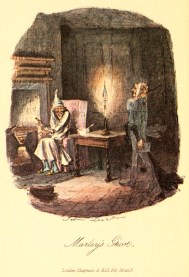
Christmascarol1843_--_040“Marley was dead, to begin with. There is no doubt whatever about that. The register of his burial was signed by the clergyman, the clerk, the undertaker, and the chief mourner. Scrooge signed it. And Scrooge’s name was good upon ‘Change for anything he chose to put his hand to. Old Marley was as dead as a doornail.”
In that first paragraph, Dickens offers us the bait. He sinks the hook and reels in the fish (the reader) by foreshadowing the story’s first plot point–the visitation by Marley’s ghost. We want to know why Marley’s unquestionable state of decay was so crucial that the conversation between us, the readers, and Dickens, the author, was launched with that topic.

Dickens doesn’t talk down to his readers. He uses the common phrasing of his time as if he were speaking to us over tea — “dead as a doornail,” a phrase that is repeated for emphasis. This places him on our level, a friend we feel comfortable gossiping with.

He returns to the thread of Marley several pages later, with the little scene involving the doorknocker. This is where Scrooge sees the face of his late business partner superimposed over the knocker and believes he is hallucinating. This is more foreshadowing, more bait to keep us reading.

At this point, we’ve followed Scrooge through several scenes, each introducing the subplots. We have met the man who, as yet, is named only as ‘the clerk’ in the original manuscript but whom we will later know to be Bob Cratchit. We’ve also met Scrooge’s nephew, Fred, who is a pleasant, likeable man.

These subplots are critical, as Scrooge’s redemption revolves around the ultimate resolution of those two separate mini stories. He must witness the joy and love in Cratchit’s family, who are suffering but happy despite living in grinding poverty (for which Scrooge bears a responsibility).

We see that his nephew, Fred, though orphaned, has his own business to run and is well off in his own right. Fred craves a relationship with his uncle and doesn’t care what he might gain from it financially.

By the end of the first act, all the characters are in place, and the setting is solidly in the reader’s mind. We’ve seen the city, cold and dark, with danger lurking in the shadows. We’ve observed how Scrooge interacts with everyone around him, strangers and acquaintances alike.

Now we come to the first plot point in Dickens’ story arc: Marley’s visitation. This moment in a story is also called “the inciting incident,” as this is the point of no return. Here is where the set-up ends, and the story takes off.

Dickens understood how to keep a reader enthralled. No words are wasted. Every scene is important, every scene leads to the ultimate redemption of the protagonist, Ebenezer Scrooge.

This is a short tale, a novella rather than a novel. But it is a profoundly moving allegory, a parable of redemption that remains pertinent in modern society.

In this tale, Dickens asks you to recognize the plight of those whom the Industrial Revolution has displaced and driven into poverty and the obligation of society to provide for them humanely.

This is a concept our society continues to struggle with and perhaps will for a long time to come. Cities everywhere struggle with the problem of homelessness and a lack of empathy for those unable to afford decent housing. Everyone is aware of this problem, but we can’t come to an agreement for resolving it.

A Christmas Carol remains relevant even in today’s hyper-connected world. It resonates with us because of that deep, underlying call for compassion that resounds through the centuries and is, unfortunately, timeless.

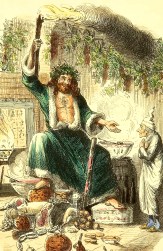
Ghost_of_Christmas_Present_John_Leech_1843As I mentioned before, this book is only a novella. It was comprised of 66 handwritten pages. Some people think they aren’t “a real author” if they don’t write a 900-page doorstop, but Dickens proves them wrong.
One doesn’t have to write a novel to be an author. Whether you write blog posts, poems, short stories, novellas, or 700-page epic fantasies, you are an author. Diarists are authors. Playwrights are authors. Authors write—the act of creative writing makes one an author.

And now, about the featured images. The two illustrations are by John Leech from the first edition of the novella published in book form in 1843.  We’re fortunate that the original art of John Leech, which Dickens himself chose to include in the book, has been uploaded to Wikimedia Commons. Thanks to the good people at Wikimedia, these prints are available for us all to enjoy.

From Wikipedia: John Leech (August 29, 1817 – October 29, 1864, in London) was a British caricaturist and illustrator. He is best known for his work for Punch, a humorous magazine for a broad middle-class audience, combining verbal and graphic political satire with light social comedy. Leech catered to contemporary prejudices, such as anti-Americanism and antisemitism, and supported acceptable social reforms. Leech’s critical yet humorous cartoons on the Crimean War help shape public attitudes toward heroism, warfare, and Britain’s role in the world. [1]

I love stories of redemption–and A Christmas Carol by Charles Dickens remains one of the most beloved tales of redemption in the Western canon. Written in 1843 as a serialized novella, A Christmas Carol has inspired a landslide of adaptations in both movies and books.

Dickens was an indie, as all writers were at that time. His essays and many short stories were published in several well-known magazines, but that paid little. He still worked hard to support his family with his writing, touring constantly to sell his work.

But we remember him and his works today. His great talent for storytelling gives us permission to write what we are inspired to.

And that brings me back to Aaron Volner. If you need a narrator, Aaron is amazing, and you can contact him at  https://aaronvolner.com/contact/. And if you’re interested in creative, well-written fantasy, his book page is https://aaronvolner.com/books/. I highly recommend his books!

May the holiday season and New Year find you and your loved ones happy and healthy, and may you have many opportunities to tell your stories.


CREDITS AND ATTRIBUTIONS:

[1] Wikipedia contributors, “John Leech (caricaturist),” Wikipedia, The Free Encyclopedia, https://en.wikipedia.org/w/index.php?title=John_Leech_(caricaturist)&oldid=871947694 (accessed December 20, 2025).

Wikimedia Commons contributors, “File:Christmascarol1843 — 040.jpg,” Wikimedia Commons, the free media repository, https://commons.wikimedia.org/w/index.php?title=File:Christmascarol1843_–_040.jpg&oldid=329166198 (accessed December 20, 2025)

A colourised edit of an engraving of Charles Dickens’ “Ghost of Christmas Present” character, by John Leech in 1843. Wikimedia Commons contributors, “File:Ghost of Christmas Present John Leech 1843.jpg,” Wikimedia Commons, the free media repository, https://commons.wikimedia.org/w/index.php?title=File:Ghost_of_Christmas_Present_John_Leech_1843.jpg&oldid=329172654 (accessed December 20, 2025).

3 Comments

Filed under writing

#FineArtFriday:A French paddle tug bringing a barque into Boulogne Harbour in heavy weather by Thomas Bush Hardy

Artist: Thomas Bush Hardy (1842–1897)

Title: A French paddle tug bringing a barque into Boulogne harbour in heavy weather

Genre: marine art

Date: 19th century

Medium: oil on canvas

Dimensions: Frame: 556 mm x 1162 mm x 75 mm; Painting: 332 mm x 945 mm

Collection: Royal Museums Greenwich

Current location: Royal Museums Greenwich


What I like about this painting:

I love seascapes and especially depictions of storms. There is something compelling about the ferocity of nature … unless you are caught up in it. Thomas Bush Hardy shows us this quite clearly.

In the foreground, rocks jut from the waves, lurking and ready to destroy any vessel that should be dashed against them.

A crowd has overloaded the pier, watching as several ships loaded with passengers are tossed violently, with a steam-tug attempting to bring one safely into the harbor. One can almost feel the passengers’ fear, hear their prayers.

I hope they all made it to shore unharmed.

I also hope the pier didn’t collapse under the weight of the onlookers.

Here on the eastern shore of the North Pacific, we expect the winter weather to be cold and rainy, with snow politely falling in the mountains where it belongs and rivers and streams keeping to their banks as they should.

Frankly the weather here has been frightful, to paraphrase a popular Christmas song. Western Washington State has been beset with torrential rains and severe flooding. Many communities are cut off because of roads and bridges that have been washed away. I am fortunate, in that my neighborhood is on higher ground, and while my extended family is impacted by road and bridge closures, they are all safe.

About this painting via Wikimedia Commons:

A French paddle tug bringing a barque into Boulogne harbour in heavy weather

A dramatic painting showing a French paddle tug bringing a barque into the port of Boulogne. The event takes place in very heavy weather and the sea is shown crashing against the harbour wall at Boulogne on the left. The paddle tug can be seen in the centre of the picture, flying the French flag. Her smoke belches out as she struggles through the mountainous sea to the aid of the barque shown behind the tug with her sails lowered. Wreckage can be seen in the foreground and there is other shipping in the distance. On the harbour wall a large crowd has gathered to witness the rescue. [1]

About the artist, via Thomas Bush Hardy – Government Art Collection:

(1842 – 1897)

Thomas Bush Hardy, marine artist, was born in Sheffield. As a youth he travelled to America, where he fought on the side of the Union during the Civil War of 1860 to 1865. He then lived in France and Holland, before returning to England. He is best remembered for his paintings of the River Thames and English coastal shipping scenes. He regularly exhibited work at the Royal Academy and the New Watercolour Society between 1871 and 1897 and, in 1884, was elected a member of the Royal Society of British Artists. He died in London on 15 December 1897 and was survived by eight children, of whom three became artists, the most well-known being Dudley Hardy (1867-1922), a painter and illustrator. [2]


Credits and Attributions:

IMAGE: Wikimedia Commons contributors, “File:A French paddle tug bringing a barque into Boulogne harbour in heavy weather RMG BHC2367.tiff,” Wikimedia Commons, https://commons.wikimedia.org/w/index.php?title=File:A_French_paddle_tug_bringing_a_barque_into_Boulogne_harbour_in_heavy_weather_RMG_BHC2367.tiff&oldid=995747273 (accessed December 17, 2025).

[1] Wikimedia Commons contributors, “File:A French paddle tug bringing a barque into Boulogne harbour in heavy weather RMG BHC2367.tiff,” Wikimedia Commons, https://commons.wikimedia.org/w/index.php?title=File:A_French_paddle_tug_bringing_a_barque_into_Boulogne_harbour_in_heavy_weather_RMG_BHC2367.tiff&oldid=995747273 (accessed December 17, 2025).

[2]  Explore Thomas Bush Hardy, Department for Culture Media and Sport contributors, © 2025  Crown Copyright, https://artcollection.dcms.gov.uk/person/hardy-thomas-bush/ (accessed December 17, 2025).

2 Comments

Filed under #FineArtFriday

Exploring theme and morality: contrasts #writing

A few years ago, I wrote a short story for an anthology on the theme of Escape, published by the Northwest Independent Writers Association (NIWA). My story was titled “View from the Bottom of a Lake.” The genre of that story is not fantasy, although it is a dream, a memory of a time gone by.

One of the requirements for that anthology was that all stories must be set in the Pacific Northwest. I set mine in an environment I knew well, the shore of the lake that dominated my early years. With my setting established, I went online and looked up every synonym for the second requirement, which was the theme: “escape.”

Then, after I had all the synonyms, I looked for the antonyms, the opposites.

Capture. Imprisonment. Confront.

Universal Literary Themes such as braverym coming of age, etc.Once I had a full understanding of all the many nuances of the theme, I asked myself how I could write a story set in an environment I knew and loved. My solution was to set it in the late 1950s. Anything that is history may as well be fantasy because the victors write the history books.

Then, I began plotting.

The main theme of escape had to form the backbone of the plot, that was a given. I asked what my character needed most in her effort to escape. My gut answer was courage.

The first subtheme, the one that formed my main character, was courage. She is underage, fearful of her narcissistic mother, and armed with the knowledge of what she must do to escape.

Every day, she escapes her mother’s disdain by swimming in the lake and staying underwater as long as she can. In those brief moments of freedom, she plans for her long-term escape, determined that once she goes away to college, she won’t return. Her grandmother, who is also a prisoner in that household, is determined to help her escape by paying for her education.

Plot is the frame upon which the themes of a story are supported.The story loops around my protagonist’s fractured family and their twisted relationship with the nearest neighbors.

The second subtheme is hypocrisy. This is a theme of morality, of “do as I say, not as I do.” The parents live out their failed dreams through their children. The girl is forced to take ballet lessons that she despises, and the boy must play football. The girl’s mother is a former ballerina who got pregnant and had to get married, ending her career before it got started. The boy’s father’s glory days were his years as a small-town jock, before WWII changed everything.

In their social world, appearances are everything. And everything is colored by her mother and his father and what everyone knows but cannot speak of.

The final subthemes of that story are hope and perseverance, and in many ways, those themes are the most important.

For the girl, romance with the boy next door is still only a possibility, but the seeds are there through their lifelong friendship. Their plans will come to fruition if only they can survive their senior year and graduate with high grades. All they have to do is endure the pressure cookers of their homes for one more year, and they will achieve their post-high school dreams.

Thus, contrasts drive that short story, and strong themes enabled me to write that tale in three days. The brilliant Lee French was the editor for Escape, and her input was invaluable. View from the Bottom of a Lake is (in my opinion) my best work. Ever.

So, what can I take from that experience to breathe life into my current work-in-progress?

First, I need to identify the overall theme for this half of the story. A comprehensive list of literary themes can be found here: A Huge List of Common Themes – Literary Devices.

The main theme, as I see it now, is two-fold. The theme of religion is explored in the war of the gods, and how a lust for power corrupts one of them.

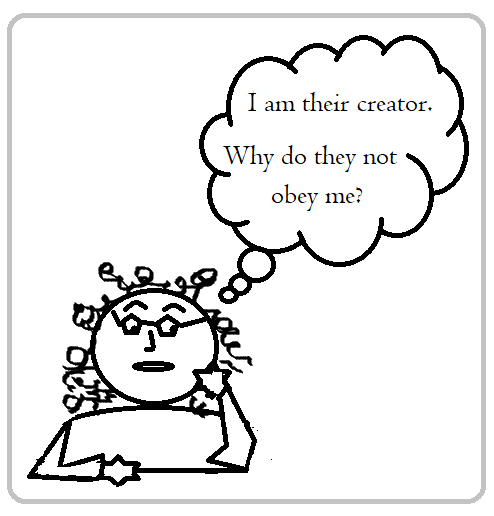
Cartoon: I am their creator. Why do they not obey me?The mortals are the playing pieces in their great game. For the people who must live their lives in the shadow of this war, the more immediate theme of change in the face of tradition underpins the plot. It is explored through the protagonist’s quest to save his people despite their stubborn clinging to xenophobic traditions.

  • My protagonists do have some allies, but they must unite the tribes and convince them of the danger presented by the antagonist.
  • My antagonist knows how the more traditional tribes fear change and ruthlessly stokes that fire.

The enemy presents himself as the man who will keep to the old ways, even though it means abandoning the Goddess Aeos and switching their loyalty to the Bull God. He lies to them about that minor detail, but justifies it as a good lie, a necessary lie.

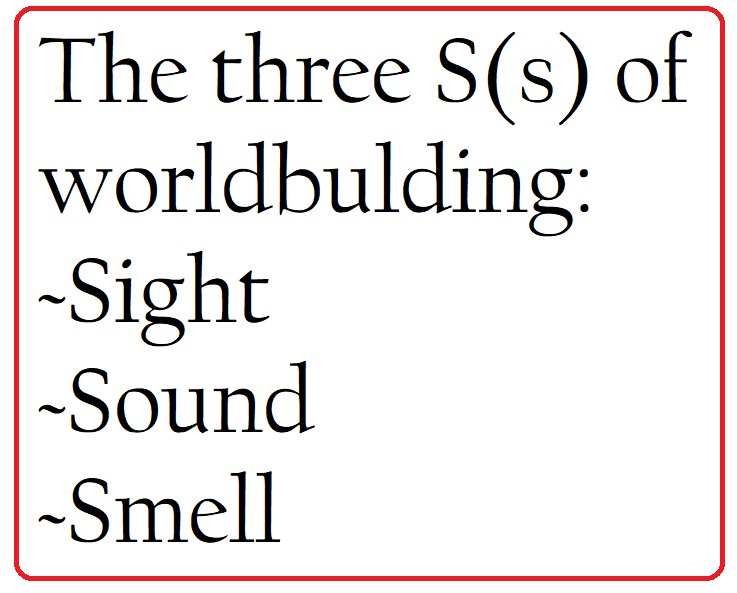
The 3 S(s) of worldbuilding: Sight, Sound, Smell.So, a third subtheme that runs through the second half of this story is morality. The antagonist can manipulate things and people to achieve his goals. He doesn’t see this as immoral. While the villain is spreading disinformation, the protagonist must try to convey the truth to people who don’t want to hear it. He must convey the facts in such a way that even the staunch traditionalists will see how the antagonist manipulates them.

In real life, everyone is a mass of contradictions we aren’t really aware of. Sometimes, it helps if I use polarities (opposites, contrasts) to flesh out a character. They help me flesh out the protagonist and also the antagonist.

  • courage – cowardice
  • manipulative – honorable
  • truth – misinformation

Now, while I fill in the plot, I am also noting ideas that will support the themes as they come to me. Good use of contrasts will (hopefully) illuminate my characters’ motives and intentions as they work toward the final goal.

Over the next year, I will expand on all these themes and bring this epic to the desired conclusion.

I talk a lot about craft, and yes, it is important. But I believe the most important aspect of the writing process is to have passion for the characters and their story. Writing always flows well when I am emotionally involved.

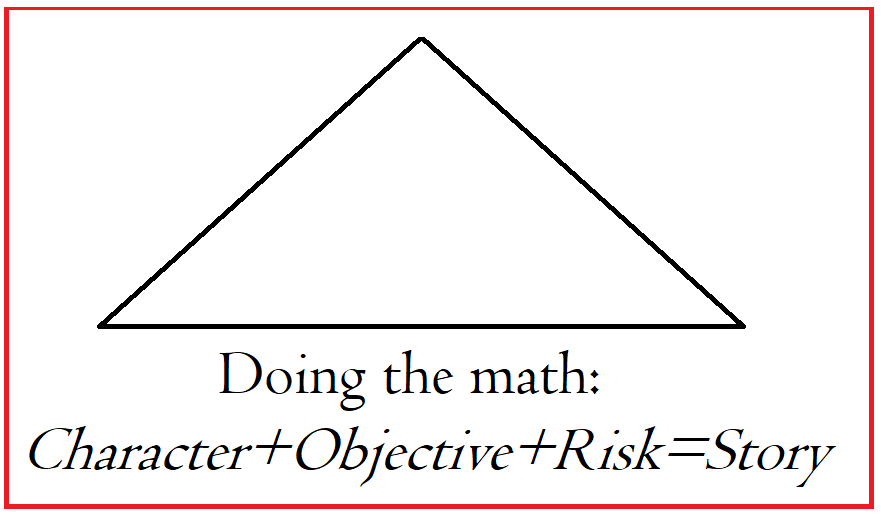
How is your writing going? Are you able to stay emotionally involved with the characters and their lives?Doing the math: Character + Objective + Risk = Story

Leave a comment

Filed under writing

#FineArtFriday: Traditions of Christmas by Adolph Tidemand 1846

Artist: Adolph Tidemand (1814–1876)

Title: Norwegian Christmas Tradition

Date: 1846

Medium: oil on canvas

Dimensions: height: 69 cm (27.1 in)

Collection: Trondheim art museum

Inscriptions: Signature and date bottom right: A. Tidemand 46. Df.


What I love about this painting:

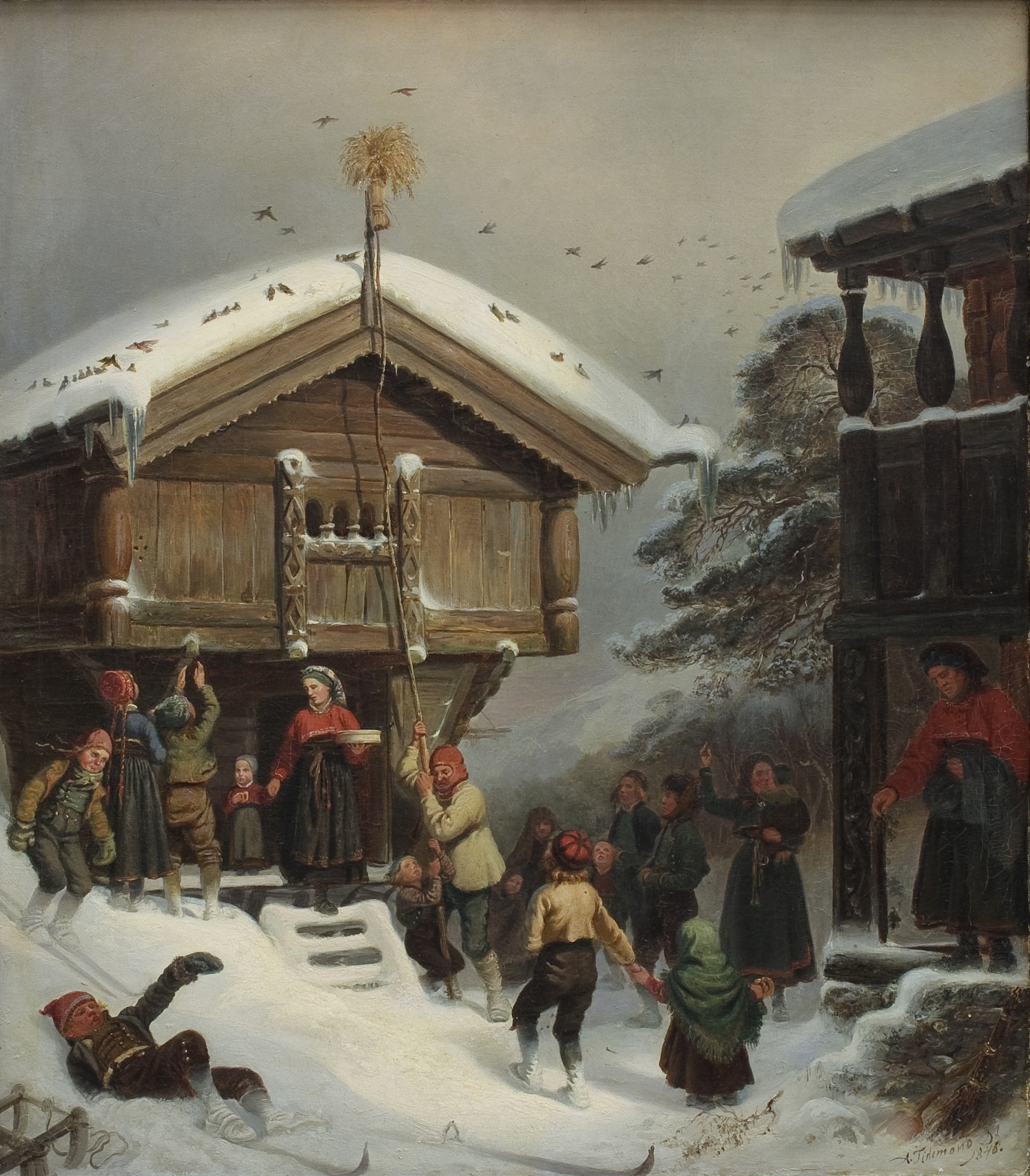
Adolph Tideman shows us a community gathering in front of a traditional Norwegian store house, a stabbur. Everyone is having fun, enjoying traditional winter activities. For me, the stabbur is the most interesting part of this painting. I love the architecture, the way it is constructed to protect the foods and items stored within it.

I also love the birds who circle above and roost on it. They are partaking of the feast offered by the sheaf of grain, apparently enjoying the festivities happening in the street below.

In Norway, the hoisting of a sheaf into the air during Christmas is a tradition known as Julenek or Kornband. They hang a sheaf of oats or grain on a pole near homes and barns to attract birds for an avian Christmas dinner. According to the article, Julenek – Christmas Sheaf A Norwegian Tradition | Norway with Pål, “It symbolizes good luck and is believed to bring prosperity for the coming year. Historically, it was thought to be an offering to the gods or a way to protect against evil forces. The sheaf is typically hung on Christmas Eve and is a common sight during the holiday season in Norway.” [1]

About the stabbur, via the Scandinavian Heritage Association website:

“Trunks with clothing and valuables were stored on the upper floor. Food and commodities were stored on the ground floor. Water and rodents were the biggest enemies in a storehouse. Stilts raised the floor level, the wooden steps did not come into contact with the building to reduce the possibility of rodent infestation and meat/cheese was hung from the ceiling.” [2]

About this painting, via the Trondheim Kunstmuseum:

” In this painting of modest size the pictorial space is packed with people who perform different tasks, all dressed in Norwegian national costumes. The store house is the centre of attention, and on the roof a sheaf is hoisted into the air, a Norwegian Christmas custom.” [3]

About the Artist, via Wikipedia:

Adolph Tidemand (14 August 1814 – 8 August 1876) was a noted Norwegian romantic nationalism painter. Among his best known paintings are Haugianerne (The Haugeans; 1852) and Brudeferd i Hardanger (The Bridal Procession in Hardanger; 1848), painted in collaboration with Hans Gude. [4]

To read more about this extraordinary artist’s life, go to  Adolph Tidemand – Wikipedia


Credits and Attributions:

IMAGE: Wikimedia Commons contributors, “File:Adolph Tidemand – Norwegian Christmas Tradition – Norsk juleskik – TKM-1-1867 – Trondheim kunstmuseum (cropped).jpg,” Wikimedia Commons, https://commons.wikimedia.org/w/index.php?title=File:Adolph_Tidemand_-_Norwegian_Christmas_Tradition_-_Norsk_juleskik_-_TKM-1-1867_-_Trondheim_kunstmuseum_(cropped).jpg&oldid=1030315615 (accessed December 11, 2025).

[1] Quote from Julenek – Christmas Sheaf A Norwegian Tradition | Norway with Pål © 2025 Pål Bjarne Johansen, Norway with Pål (Accessed December 11, 2025).

[2] Quote from Stabbur – Scandinavian Heritage Association © 2025 Scandinavian Heritage Association Contributors, (accessed December 11, 2025).

[3] Quote from Adolf Tideman – Trondheim kunstmuseum © 2025 Trondheim Kunstmuseum Contributors (accessed December 11, 2025).

[4] Wikipedia contributors, “Adolph Tidemand,” Wikipedia, The Free Encyclopedia, https://en.wikipedia.org/w/index.php?title=Adolph_Tidemand&oldid=1325534158 (accessed December 11, 2025).


2 Comments

Filed under #FineArtFriday, writing

Heroes and Villains #writing

If you read last week’s post, you know that I am working on both the hero and villain of my work-in-progress.

And now that it is December, I can expand on each character’s theme, a sub-thread that is solely theirs. A personal theme can shape how each character reacts and interacts throughout the narrative. The themes were established in the first book, but they (and the characters) will evolve as the story does.

Themes emphasize the motivations of our characters and underscore both strengths and weaknesses.

For example, a villain’s personal theme might be hubris (excessive self-confidence). It can also be a hero’s theme. It is a high degree of arrogance, and terrible decisions can arise from it.

A hero’s personal theme might be honor and loyalty. This might also be their weakness, as it can undermine their ability to act decisively. In trying to save someone she desperately loves, others might suffer. In Star Trek terms, the good of the one can exceed the good of the many, and people will die that could have been saved. Who is the villain in that case?

Sometimes, there is little distinction between heroes and villains in real life. Some heroes are jackasses who need to be taken down a notch. Some villains will extort protection money from a store owner and then turn around and open a soup kitchen to feed the unemployed.

Al Capone famously did just that. Mobster Al Capone Ran a Soup Kitchen During the Great Depression – HISTORY.

In reality, heroes are flawed because no one is perfect. So, don’t be too shocked and heartbroken when a public figure you admire is discovered to have personal failings. Most of the time, those failings are only a small part of their character, as we hope our own weaknesses are.

When I first designed my characters, I assigned them verbs, nouns, and adjectives, traits they embody. They must also have a void, an emotional emptiness, a wound of some sort.

The void is necessary because characters must overcome personal cowardice to face it. As a reader, I’ve noticed that my favorite characters each have a hint of self-deception. All the characters deceive themselves about their own motives.

The heroes we admire eventually recognize their flaws and become stronger, able to do what is necessary. The villains may also acknowledge their fatal flaw but use it to justify and empower their actions.

I like heroes and villains with possibilities. I like believing that the villain might be redeemed, or the hero might become the villain.

That is why in my current work, the tragic hero who becomes the villain is central to my story. In other stories, I have explored the broken hero, the one who rises from the ruins of their life to save the day. So, it just seemed right to consider a hero who fights with all his heart but for the wrong side.

My creative mind works by having plots and characters evolve together. When I sit down to create a story arc, my characters offer hints about how they will develop. Themes emerge, and their evolution can alter the course of different character arcs.

Who in your work will be best suited to play the villain? Character B?

Conversely, why is character A the hero?

In the early stages of a first draft, I know who the hero and the antagonist are. But until I know who they are when they are off duty and enjoying their downtime, I don’t really know them.

No matter what genre we write in, when we design the story, we build it around a need that must be fulfilled, a quest of some sort. The story needs a theme, each character needs a theme, and once I know what those themes are, I will have the heart of it.

Of course, for my protagonist, the quest to unite his world is the primary goal. But he has secrets, underlying motives not explicitly stated at the outset. There is a theme to those secrets. The same goes for my villain.

Now that I am building the second half of the story, my supporting characters also have agendas that conflict with the hero’s. Their role in that story is affected by their personal ambitions and desires. My hero’s first quest is to get them to shed their xenophobia.

The antagonists also have motives, both stated and unstated. They need to thwart the protagonist and must have a logical reason for doing so. They have a history that goes beyond the obvious “they needed a bad guy, and I’m it” of the cartoon villain.

No one goes through life acting on impulses for no reason whatsoever. On the surface, an action may seem random and mindless. The person involved might claim there was no reason or even be accused of it, but that is a fallacy, a lame excuse they might offer to conceal the secret that really drives them.

Half of this story is written and will not be published as a novel until its sequel is ready for publication. I can see the whole story, but the details are blurry. So, I have an idea of what the entire story will be. And now as I write, the second half of this story unfolds.

As a reader, I dislike discovering the author doesn’t really know how to get what their protagonist wants. I always have the urge to tell them that a working relationship with a trusted editor could have helped a great deal. A strong personal theme would help identify what each character needs and wants. Random events inserted to keep things interesting don’t advance the story. But motivation does, and using themes can lead the writer to it.

Character creation crosses all genres. I write fantasy, but even if you are writing a memoir detailing your childhood, the basics of story telling come into play. You are telling a story about the person you were in those days. What were the themes that bound your experiences together? You want the reader to see the events that shaped you, not through the lens of memory, but as if they were observing them unfold.

No matter the genre you write in, some things are universal. Who are your characters? Who do they love, and who do they despise? How can a strong personal theme emphasize a character’s personality?

I hope your work is progressing well. In the darkness of December, the Christmas lights decorating the apartment building across the way cheer me up. They make the eternal Northwest rain seem less oppressive.

My favorite comfort foods and a cup of tea make for cozy evenings spent thinking about how I want this plot to go.  Writing is hard work, but it’s good work.

1 Comment

Filed under writing

#FineArtFriday: A closer look at “The Sycamores” by Alexandre Calame 1854

1175px-'The_Sycamores'_by_Alexandre_Calame,_Cincinnati_Art_MuseumTitle: The Sycamores by Alexandre Calame

Genre: landscape art

Date: 1854

Medium: oil on canvas

Dimensions: height: 54.3 cm (21.3 in)

Collection: Cincinnati Art Museum

What I love about this painting:

I live in the Pacific Northwest, a part of the world where sycamore trees do not grow in the wild. They are native to the eastern United States and are often featured as part of the landscape in 18th and 19th-century American literature.

The trees featured in this painting are European Sycamores. When I first came across this painting in 2022, I was impressed by both their size and the rough, boulder-strewn landscape that is their home.

These are trees with a presence. They grow on a sunlit hillside and seem as tough as the boulders surrounding them. Storms may come and go, but these trees remain.

Like people, these trees have seen some stuff. No delicate hothouse specimens here; these are sturdy peasant trees, able to make do with whatever nature throws at them.

About the Artist, via Wikipedia:

Alexandre Calame (28 May 1810 – 19 March 1864) was a Swiss landscape painter, associated with the Düsseldorf School.

He was born in Arabie at the time belonging to Corsier-sur-Vevey, today a part of Vevey. He was the son of a skillful marble worker in Vevey, but because his father lost the family fortune, Calame could not concentrate on art, but rather he was forced to work in a bank from the age of 15. When his father fell from a building and then died, it was up to the young Calame to provide for his mother.

In his spare time he began to practice drawing small views of Switzerland. In 1829 he met his patron, the banker Diodati, who made it possible for him to study under landscape painter François Diday. After a few months he decided to devote himself fully to art.

In 1835 he began exhibiting his Swiss-Alps and forest paintings in Paris and Berlin. He became quite well known, especially in Germany, although Calame was more a drawer than an illustrator. He is associated with the Düsseldorf school of painting. In 1842 he went to Paris and displayed his works Mont Blanc, the Jungfrau, the Brienzersee, the Monte Rosa and Mont Cervin.


Credits and Attributions:

Wikimedia Commons contributors, “File:’The Sycamores’ by Alexandre Calame, Cincinnati Art Museum.JPG,” Wikimedia Commons, the free media repository, https://commons.wikimedia.org/w/index.php?title=File:%27The_Sycamores%27_by_Alexandre_Calame,_Cincinnati_Art_Museum.JPG&oldid=618822225 (accessed December 4, 2025).

Wikipedia contributors, “Alexandre Calame,” Wikipedia, The Free Encyclopedia, https://en.wikipedia.org/w/index.php?title=Alexandre_Calame&oldid=1088977147 (accessed December 4, 2025).

5 Comments

Filed under #FineArtFriday